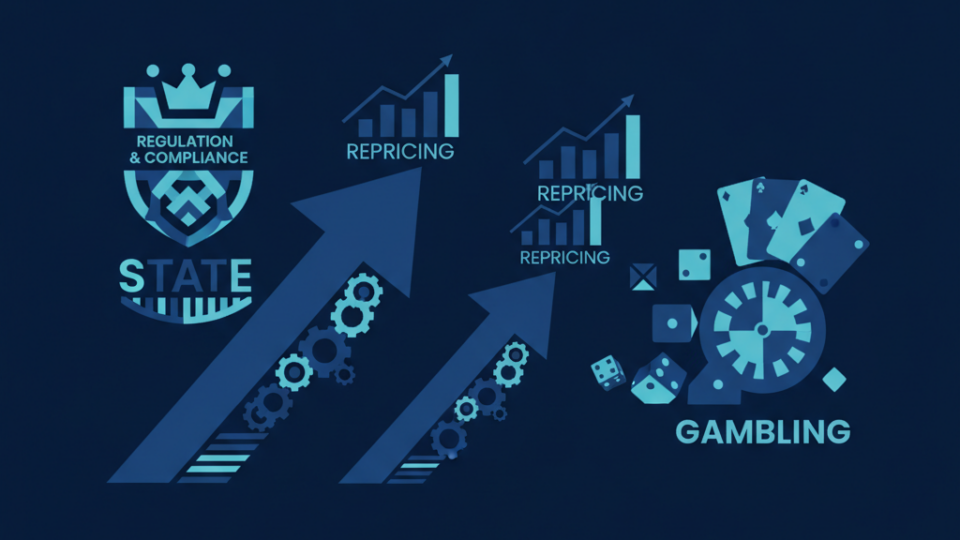
Across four jurisdictions, the state has just repriced its claim on gambling: Britain has pushed Machine Games Duty to 25 per cent, an Australian federal court has ordered a A$260 million penalty, Ontario is asking new casino operators for a CA$100 million entrance fee before a single chip is dealt, and Brazil has prohibited fixed-odds betting outright. Each measure prices the state’s take as though gaming yield were a stable, growing base. The same week’s operator disclosures — falling Las Vegas revenue at Caesars, New York sportsbook revenue down on handle up — suggest the base is anything but. That is the tension this publication sees: a fixed, rising rate applied to a volatile, flattening base, with enforcement capacity scaling slower than fiscal ambition.
What happened
CasinoBeats and G3 Newswire report that the Chancellor has raised Machine Games Duty to 25 per cent, a five percentage point increase on the previous standard rate of 20 per cent, taking effect in April 2027. From that date, a maximum charge above £1 or a maximum prize above £100 will be enough to trigger the higher rate. In practice, bingo halls, betting shops and casinos will pay 25 per cent on their Category B machines, while pubs and seaside arcades keep the lower rate. Betting shops and casinos avoided the 40 per cent machine tax rate some in the sector had feared.
The increase does not arrive alone. Per G3 Newswire, online remote gaming duty rose to 40 per cent in April 2026 and general betting duty is due to rise to 25 per cent in April 2027, as part of what the Betting and Gaming Council describes as last year’s £1.7 billion tax raid. Beneath the rate sits a liability change the Budget has already announced. Today, suppliers are not liable for Machine Games Duty even when they share in machine takings; the person responsible for the premises registers and pays. From 1 April 2028, Budget 2026 moves duty liability to the machine supplier for supplier-owned machines operated under profit-share arrangements, while premises that own their machines, or hold them under a fixed rental or lease and control the takings, remain liable. HMRC’s consultation on how the change should work closes on 20 January 2027. The Treasury scores the rate rise and the liability shift together at £135 million in 2027-28 and £150 million in 2028-29, then around £145 million a year.
In Australia, Casino.org reports that a federal court ordered The Star Entertainment Group to pay A$260 million (US$183 million) for breaching anti-money laundering and counter-terrorism financing laws. AUSTRAC applied to the Federal Court for civil penalty proceedings in November 2022. The regulator asked for A$400 million and Star argued for A$100 million; the order falls between the two.
In Ontario, the Call for Investment under the Destination Niagara Strategy aims to attract more than CA$3 billion (US$2.1 billion) in direct gaming investment and more than CA$600 million (US$429 million) in additional private sector investment across the strategy’s components over 20 years. Under the proposal terms, each new operator must commit a minimum investment of CA$1.5 billion (US$1.07 billion) and pay a CA$100 million (US$71 million) upfront entrance fee.
In Brazil, Provisional Measure 1,394/2026, published on 25 September 2026, prohibits the operation, offering, intermediation and advertising of fixed-odds betting, covering sports betting and online games, according to G3 Newswire. The industry’s Supreme Court challenge was filed in September 2026, when the National Association of Games and Lotteries sought suspension of the measure.
Against that, the operator numbers. CasinoBeats reports Caesars Entertainment group revenue rose 2.5 per cent year on year to $2.94 billion in the third quarter of 2026, but consolidated adjusted EBITDA fell to $865 million from $884 million. Las Vegas net revenue slipped 2.3 per cent to $930 million from $952 million, with Las Vegas segment earnings falling by a larger percentage than revenue.
In New York, Casino.org reports that over the first six months of the 2026–27 fiscal year, sports betting handle reached nearly $12.6 billion, up 6.9 per cent year on year — while sportsbook gross revenues fell 5.8 per cent to $1.1 billion, as the average win percentage dropped from 10 per cent to 8.8 per cent because bettors fared better. And in Namibia, iGaming Business reports that Environment, Forestry and Tourism minister Indileni Daniel told parliament the Gambling Board was not yet fully operational and that staff were still to be recruited, with the lack of personnel limiting consumer education and rehabilitation programmes.
Why it matters
Our reading is that fiscal policy is being written against an assumed revenue curve that operators are not currently delivering. Britain’s rate stack — 40 per cent remote gaming duty already in force since April 2026, general betting duty and Machine Games Duty both moving to 25 per cent in April 2027 — compounds on each channel in sequence. Yet Caesars, one of the sector’s largest listed operators, grew group revenue 2.5 per cent while consolidated EBITDA fell, and saw its flagship Las Vegas earnings decline faster than its Las Vegas revenue. Rates are ratcheting upward; margins, on this evidence, are not.
New York makes the mechanical point sharper. Handle rose 6.9 per cent and revenue fell 5.8 per cent, because hold moved 1.2 points in bettors’ favour. Revenue-linked tax bases swing materially year to year on outcomes nobody legislates for. Statutory rates, by contrast, only move in one direction. A treasury forecasting receipts off a gross-revenue base is forecasting something considerably less predictable than the rate it applies to it.
The enforcement side of the ledger is where the asymmetry becomes uncomfortable. AUSTRAC filed against Star in November 2022; the A$260 million order arrived years later, and at a figure well short of the A$400 million sought. Namibia, meanwhile, has a gambling board that is not yet fully operational, with consumer education and rehabilitation constrained by vacancies. Governments are proving considerably quicker at setting their take than at building the supervisory capacity that take is nominally meant to underwrite.
Brazil and Ontario mark the two poles of the same instinct. Brazil has moved to prohibit fixed-odds betting outright — the end state of repricing, where the licensed taxable base disappears pending the courts. Ontario has gone the other way, proposing to monetise market access up front through a CA$100 million entrance fee and CA$1.5 billion minimum commitments in pursuit of CA$3 billion of direct investment. Both are claims on the same uncertain future cash flows.
The case against
The first objection is that the UK state moderated rather than squeezed: betting shops and casinos avoided the 40 per cent machine rate some feared, and 25 per cent is a five-point rise, not a doubling. That is fair, and our argument does not rest on worst-case advocacy figures. It rests on the verified stack — three separate rate movements across remote gaming, general betting and machines, announced in two consecutive Budgets and taking effect twelve months apart (April 2026 and April 2027) — set against operator earnings that are flat to falling.
The second is that New York’s revenue decline is hold variance, not structural decline: bettors simply fared better, and handle rose 6.9 per cent. We concede that entirely, and it should be stated plainly. Demand is not collapsing. The point is precisely that the base is noisy in a way the rate is not.
The third is that capital remains confident — Ontario is courting CA$3 billion of direct investment on proposal terms that would require each new operator to pay a CA$100 million entrance fee. Those terms are still before prospective operators, with responses to the first procurement phase due by 3 December 2026; no bidder has yet been reported as accepting them. If credible operators do, that is consistent with our reading rather than contrary to it: capital is visibly rotating toward new markets and new formats while Las Vegas revenue and earnings decline.
The fourth objection is the hardest. These are unrelated decisions in unrelated jurisdictions, and the pattern may be an artefact of the publishing calendar. We claim no causal link, and the evidence cannot establish one. What is common and checkable is narrower: in each case the state has fixed its take without a published assessment of the paying channel’s capacity to carry it.
What should happen
These are this publication’s recommendations, not findings. HM Treasury and HMRC should publish the behavioural assumptions behind the £135 million Machine Games Duty forecast before the rate rises in April 2027, and use the consultation that closes on 20 January 2027 to settle how supplier liability will work from 1 April 2028 — in particular how fixed-rental and lease arrangements, which the proposal leaves with premises operators, are to be distinguished from profit-share — so that venues and suppliers can reprice their contracts on known rules rather than on guidance acknowledged to be changing.
The Betting and Gaming Council should publish, in full, the venue-level modelling behind its characterisation of a £1.7 billion tax raid. Industry warnings about closures deserve to be tested on the public record rather than absorbed as advocacy or dismissed as it.
Finance ministries and regulators should ring-fence a defined share of new duty, entrance-fee and penalty income — Ontario’s CA$100 million fees and Australia’s A$260 million order are live examples — for supervisory staffing and consumer protection. Namibia’s unstaffed board is the clearest argument for doing so: a regulator that cannot run rehabilitation programmes is not a regulator that can carry a bigger market.
Operators, suppliers and investors should stress-test plans against rising statutory rates combined with a one-to-two-point adverse hold swing of the kind New York has just absorbed, and model supplier liability into machine profit-share contracts now, ahead of the 1 April 2028 change rather than after it.
What to watch
Three things would confirm this thesis. First, UK machine receipts after April 2027 coming in below forecast, with the gap concentrated in bingo halls, betting shops and casinos — the venues carrying the 25 per cent rate — rather than in pubs and arcades on the lower rate. Second, New York hold reverting toward 10 per cent while revenue growth still lags handle growth, which would indicate displacement rather than luck. Third, Brazil’s licensed base failing to return intact once the Supreme Court rules on the challenge to Provisional Measure 1,394/2026.
Three things would refute it. Namibia staffing its board on a published timetable. Ontario’s CA$100 million entrance fee clearing with multiple credible bidders and the CA$1.5 billion commitments converting into signed agreements. And Caesars-style earnings declines reversing in Las Vegas while duty rises land without venue closures. We put our confidence in this reading at moderate, not high. The pattern is real; the causation is not yet established, and we will say so until it is.
This analysis was produced with AI assistance and reviewed by a human editor for both factual accuracy and editorial position. Editorial judgments are identified as such. Editorial responsibility: Sven Karlsson, Editorial Lead.
Sources
- Budget 2026 — HM Treasury, official primary source (published 2026-10-28)
- Machine Games Duty: changing who is liable for the duty — HMRC consultation, official primary source (published 2026-10-28)
- Machine Games Duty: Budget pulls Category B machines into 25% rate from April 2027 — Authoritative secondary source (published 2026-10-29)
- Ontario Opens Niagara Casino Market to New Operators, Targets $3B Investment — Independent reporting (published 2026-10-29)
- Brazil’s top court to hear government and industry on betting ban — Independent reporting (published 2026-10-27)
- Chancellor’s gambling tax hike will cost thousands of jobs and devastate Britain’s high streets, warns BGC — Independent reporting (published 2026-10-28)
- Star Entertainment Fined A$260M Over Money Laundering and Terrorism Financing Failures — Independent reporting (published 2026-10-28)
- www.casino.org — Authoritative secondary source
- New York Sports Betting Handle Climbs in Face of Prediction Market Competition — Independent reporting (published 2026-10-28)
- Caesars Q3: Las Vegas earnings slide while regional and digital units keep growing — Authoritative secondary source (published 2026-10-28)
- Namibia advances gambling reform proposals amid regulator staffing concerns — Authoritative secondary source (published 2026-10-23)
Reporting verified against the sources above; retrieval timestamps are preserved in the editorial record.