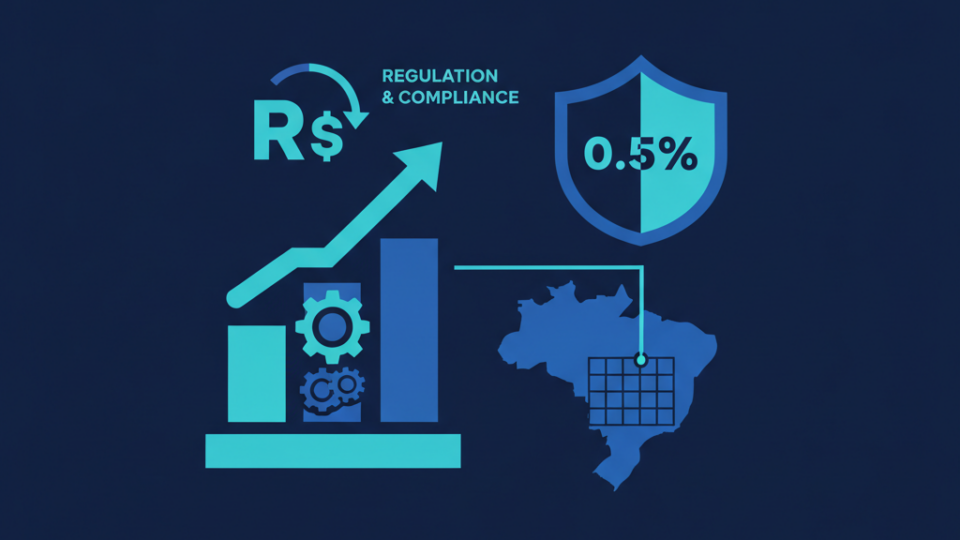
Brazil’s federal government has fixed the rate of the Imposto Seletivo — the “sin tax” created by the country’s tax reform — at 0.5% for prognostic contests, a category that under complementary legislation takes in lotteries, fixed-odds betting and fantasy sport. The rate was set by Provisional Measure No. 1,399/2026, published on the night of Wednesday 4 November 2026 in an extra edition of the Diário Oficial da União, which establishes the selective tax rates for 2027. The 0.5% figure appears in article 7 of the measure.
Because of the 90-day constitutional waiting period known as the noventena, the charge only begins to apply on 2 February 2027, under article 19 of the MP.
The text of MP 1,399 does not name lotteries, betting or fantasy sport directly. Instead it cross-refers to article 244 of Complementary Law No. 214/2025, which defines the specific regime for “concursos de prognósticos”: all lottery modalities, fixed-odds betting, sweepstakes, horse-race betting and other bets, whether physical or virtual, with a sole paragraph extending the regime to fantasy sport. In announcing the measure, the government cited the lottery games Mega-Sena, Lotofácil and Loteca as examples.
Crucially for operator modelling, the selective tax does not fall on betting turnover. Under article 414, item V of LC 214, the calculation base is the promoting entity’s own revenue, determined in accordance with article 245 as gross collection minus prizes paid and the mandatory legal allocations to bodies, public funds and other beneficiaries.
The reform also produces a cascade: the Imposto Seletivo forms part of the calculation base of the IBS and the CBS within the prognostic contests regime, so the CBS will apply to an operator’s own revenue already increased by the IS. The TCU has calculated the CBS reference rate at 11.3%, a figure that still depends on being set by the Senate by 15 December; in 2027 the CBS is reduced by 0.1 percentage point and the IBS enters at 0.1%. Article 16 of MP 1,399 provides a compensation mechanism under which estimated IS revenue reduces the CBS reference rate in 2027 so as to preserve the overall tax burden of the reform.
The regime is explicitly transitional. Article 15 requires the Executive to send Congress a bill with definitive rates by 31 May 2027, applicable from 1 January 2028, making the 0.5% a floor for a single year with no guarantee it will be maintained. MP 1,399 must also itself be voted on by Congress or it will lose validity.
Fixed-odds betting is currently prohibited in Brazil under MP 1,394/2026, yet it remains within the scope of the Imposto Seletivo: the prohibition did not alter LC 214, and could not have done so, since the Constitution (art. 62, §1, III) bars provisional measures on matters reserved to complementary law.
According to BNLData, betting could return during 2027 by three routes: a ruling by the Supreme Federal Court in the cases against MP 1,394, currently under the rapporteurship of Justice Luiz Fux; rejection of the measure by Congress; or the lapse of the MP, which the outlet calculates would occur on 4 March 2027 if it is not voted on. Fux has issued a decision that halted the legal actions against the so-called MP das Bets at the STF.
If betting does return, licensed operators in 2027 would face a combined load comprising the 14% GGR contribution under LC 224/2025 — 12% to legal beneficiaries and 2% to social security, rising to 15% in 2028 — plus the 0.5% Imposto Seletivo on own revenue from 2 February, the CBS replacing PIS and Cofins, municipal ISS, which runs until 2028 and begins phasing down in 2029, and IRPJ and CSLL on profit.
The relative scale of the new levy is modest. Based on the official 2025 GGR figure of R$36.9 billion — Finance Ministry data obtained by BNLData through a freedom-of-information request — the 0.5% IS would raise around R$159 million in a full year, against more than R$5 billion from the 14% GGR contribution on the same base. In BNLData’s assessment, the sin tax on betting in 2027 is almost symbolic, with the real weight lying in the 14% contribution and the debut of the CBS on a base inflated by the IS itself. With betting prohibited, the outlet notes, expected IS revenue from the sector is zero, while bettors who migrated to illegal sites pay neither the 0.5%, nor the 14%, nor the CBS.
State lotteries, which since MP 1,394 remain authorised to operate their other modalities but can no longer offer fixed-odds betting, will start paying the IS in 2027. Because lottery operators are taxed only on the share left after prizes and legally mandated social transfers, BNLData argues the revenue effect on lotteries tends to be small.
Fantasy sport is caught by the regime despite article 49 of Law 14,790/2023, which establishes that the activity is not a lottery modality, commercial promotion or fixed-odds bet and does not require government authorisation. LC 214 nonetheless included it in the prognostic contests regime and therefore in the selective tax. Platforms with revenue — a field whose best-known Brazilian product is Globo’s Cartola — will pay the same 0.5% on their own revenue from February 2027, and there are proposals in Congress to remove fantasy from the tax on the argument that the activity is not harmful to health.
Separately, the Ministry of Sport and the Federal Police have signed a five-year cooperation agreement against match-fixing. The deal was negotiated before MP 1,394 but arrives as the sector loses the monitoring previously provided by integrity companies that operated through partnerships with licensed betting houses.
This article was produced with AI assistance and reviewed under the GamblingZine editorial verification process.
Sources
- Imposto do pecado: MP fixa em 0,5% a alíquota sobre loterias, fantasy e bets a partir de fevereiro de 2027 — Independent reporting (published 2026-11-05)
- bnldata.com.br — Authoritative secondary source
- bnldata.com.br — Authoritative secondary source
- bnldata.com.br — Authoritative secondary source
Reporting verified against the sources above; retrieval timestamps are preserved in the editorial record.